What is the Internet of Things (IoT)?
Key Highlights
- IoT connects physical devices using sensors, software, and internet connectivity to collect and exchange data across various sectors.
- Fiber networks provide the necessary bandwidth, reliability, and scalability to support the increasing number of smart devices and data traffic.
- 5G enhances IoT capabilities with support for massive device density, ultra-low latency, and network slicing for real-time applications.
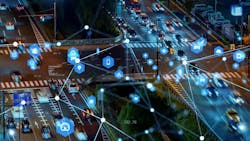
The Internet of Things (IoT) refers to the growing network of connected physical devices that collect, transmit, and exchange data over the internet.
These devices use built-in sensors, software, and connectivity to communicate with cloud platforms, industrial and enterprise systems, and sometimes each other.
What makes IoT important is not just the devices themselves, but the infrastructure needed to support them. The major contributors supporting IoT include structured cabling systems, fiber networks, and 5G connectivity.
IoT Applications in Smart Homes
Amazon Web Services notes that smart home IoT deployments focus on automation, efficiency, and security.
Some examples include:
- Smart outlets that keep track of electricity use
- Smart thermostats that can regulate and control temperature
- Door locks and surveillance cameras for home security
- Automated appliances (coffee maker, vacuum, etc.)
On their own, these devices transmit small data loads. However, as more smart devices are used in a home along with streaming, cloud storage, and other services, fiber networks are handling increased, consistent traffic.
The growing usage of smart home devices displays the importance of Fiber to the Home (FTTH) and high-performance Wi-Fi infrastructure, and is part of the reason why there has been more focus on sustained, low-latency connectivity that can support these devices.
IoT in Smart Cities and Smart Buildings
IoT deployments for government purposes are concentrated on municipal planning and infrastructure maintenance.
Smart City Uses
- Air quality and environmental monitoring
- Conserving energy and lowering bills with smart street lighting
- Checking if maintenance is needed for critical infrastructure like pipelines, roadways, and bridges
Usage in Smart Buildings
IoT applications in commercial buildings and educational facilities are utilized to increase operational efficiency.
- Optimizing building operations (HVAC, surveillance, lighting, etc.) and energy consumption
- Increasing people’s comfort by monitoring and adjusting air temperature, air quality, and lighting
- Reducing maintenance costs by consistently analyzing data
Industrial IoT (IIoT)
In manufacturing, retail, and logistics environments, Industrial IoT (IIoT) devices provide:
- Machine monitoring and anticipating maintenance needs
- Inventory tracking and management, even as it is being transported
- Enhanced safety from possible hazards
IoT in Healthcare
According to Cisco, IoT systems are critical in healthcare, requiring security and reduced latency and downtime.
Common technologies include:
- Real-Time Location Systems (RTLS) for tracking equipment and patients
- Environmental monitoring sensors for labs, pharmacies, and medicine storage
- Clinical wearables that continuously monitor and collect vitals
What Is 5G IoT?
5G IoT is the integration of fifth-generation cellular networks with IoT systems to enable higher device density, lower latency, and faster speeds.
Key benefits of 5G for IoT include:
- Support for massive numbers of connected devices
- Network slicing
- Ultra-low latency for real-time applications
Although 5G enhances wireless access, it still relies heavily on fiber infrastructure, as every system connects back to fiber networks.
The Role of Fiber Connectivity
According to Belden, fiber supports IoT in three ways:
1. Increased Bandwidth Capacity
As IoT devices multiply, the total amount of data traffic increases. Fiber networks provide the scalable backbone needed to support the growing number of smart devices being used.
2. In-Building and Industrial Deployments
Fiber provides reliable connectivity in challenging environments where wireless networks cannot operate (i.e., factories, warehouses, etc.)
3. Fiber-Based Sensors
Optical fiber sensors can be used for some IoT applications in infrastructure, utilities, and energy systems by measuring temperature, vibration, strain, etc.
Final Takeaway
The Internet of Things (IoT) is the network of connected physical devices that collect and exchange data over the internet. It has contributed to an increase in the use of smart technology in homes and cities, as well as in industrial, business, education, and healthcare settings.
Stay Connected with ISE Magazine
Subscribe to our newsletters and magazine for the latest telecom insights, explore the current issue for in-depth features and strategies, and register for upcoming webinars to learn directly from industry leaders.
About the Author

Serena Aburahma
Associate Editor | Cabling Installation & Maintenance
Serena Aburahma is an experienced editor and writer for CI&M, Lightwave, and ISE. Serena has pitched and created content for B2B and B2C audiences across various industries, including technology, video games, insurance, cars, pop culture, and more.
Much like the content Serena has written about, her interests vary as well. Aside from creative writing, she is particularly passionate about learning about everything and anything, meandering in nature, playing video games, traveling, and reading.