MDU Fiber Has Reached Its "Later" Moment
Key Highlights
- Focus on building-specific constraints to develop less invasive, cost-effective fiber installation methods that minimize resident disruption.
- Separate building readiness from subscriber activation to allow flexible, staged fiber deployment aligned with demand and revenue goals.
- Design pathways with future expansion in mind, avoiding over-commitment to current needs and enabling scalable, adaptable networks

For much of the past decade, the fiber-to-the-home market concentrated on single-family neighborhoods. The logic was understandable: those builds were more controllable, and providers could pass homes quickly. Multi-dwelling units (MDU) introduced more complexity, so the industry often treated them as a market it would come back to later.
We are at that “later” point now. Providers have a stronger realization that they need to go after MDUs, and some have figured out how to move through those deployments at greater speed. The unit economics can be attractive because one property puts many potential customers in a concentrated footprint. But density does not remove the operational challenge. Getting fiber to the building is only part of the job; providers still have to get people connected inside it.
That is especially true in the brownfield market, where the opportunity is larger than the number of new MDU starts. Existing buildings were not designed around a new fiber pathway. Walls are finished, risers are crowded, residents are actively living in the home and property owners want as little construction as possible. A deployment model built for a suburban street cannot simply be carried through the front door.
The building is not a blank slate
Traditional in-building cabling often assumes there is a clean route from a centralized distribution point to every floor and unit. Existing MDUs rarely offer that luxury. Telecom closets may be small. Risers may already contain electrical, coaxial or other communications infrastructure. Corridors and common areas may have finishes that owners do not want disturbed. Fire-safety requirements, bend limitations and access rules add another layer of complexity.
The practical result is that concealment can become one of the largest hidden costs in the project. A cable may be affordable, but the work required to route it, hide it, repair surfaces and coordinate access can quickly overwhelm the hardware savings. In an occupied building, every additional step also creates more disruption for property staff and residents.
Providers should begin with the constraints of the building rather than force a familiar outside-plant design into an indoor environment. Where can equipment be placed without consuming valuable space? Which existing surfaces can support a safe, durable route? How many times will installers need to enter a unit? Can service be added later without reopening the corridor? Those decisions shape the true cost of the retrofit.
Design around installation, not only materials
It is easy to compare fiber projects by looking at cable, enclosures and termination hardware. That is incomplete math. Our analysis of fiber deployment costs shows that labor can represent 80 to 85 percent of the installed cost, while materials typically account for 15 to 20 percent. Although every building is different, the broader lesson is highly relevant to MDUs: the installation method often matters more than the price of any single component.
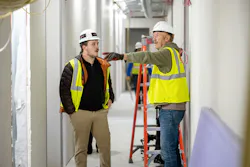
In a brownfield property, the practical goal is simple: do as little construction as possible. A slim, surface-mounted route can reduce the need to open walls or create new pathways. Fiber placed where the ceiling meets the wall can be nearly invisible—more like a bead of caulk than a traditional cable installation. Compact termination points can support individual subscriber drops, while clear drop fiber can blend into existing surfaces as it moves into a residence.
This is not only about appearance. As I often describe it, the answer is to simplify and reduce the size. Smaller infrastructure lowers visibility, but it can also lower cost by reducing drilling, concealment and restoration work. Fewer invasive steps mean fewer labor hours and less disruption for the people who live in the building.
Separate building readiness from subscriber activation
One of the most important design choices is whether every unit must be fully cabled on day one. In many buildings, take rates will build over time. Running a complete drop into every residence before the resident requests service can create unnecessary cost and scheduling friction.
A more flexible approach prepares the common pathway and establishes discreet termination points along the corridor, then completes the final subscriber connection as service is activated. This separates building-wide construction from individual unit access. Property teams do not have to coordinate entry into every apartment at once, and providers can align more of the installation expense with an actual revenue need.
The same principle supports future changes. One of the biggest traps in network planning is the belief that we can build for a future we understand. We never know exactly what that future will be. Providers can install more fiber today and still discover later that it is not enough, not the right type or not where it is needed. The better objective is to limit the need to commit today to tomorrow’s architecture. Put the pathway—the plumbing network—in place, then add fiber assets as demand requires. That reduces upfront capital while protecting flexibility for the unknown.
Aesthetics are an operating issue
In an MDU, aesthetics are sometimes treated as a secondary concern. That is a mistake. Building owners and managers are responsible for the resident experience and the long-term appearance of common areas. A technically sound design can still be rejected if it introduces bulky enclosures, visible cable trays or extensive wall repairs.
Providers should address appearance at the beginning of the design process, not after the route has been engineered. Smaller components, slim corridor boxes, discreet cable finishes and thoughtful placement can make the network less intrusive. Property owners want the advantages of fiber, but they do not want to sacrifice the look of the building to get it. Accounting for that reality early can make approvals easier and reduce the concealment work that drives cost and delays.
Good MDU design sits at the intersection of network performance, constructability, and the character of the property. Ignoring any one of those factors creates problems for the other two.
The retrofit question providers should ask
The wrong question is, ‘How do we install our standard fiber design in this building?’ The better question is, ‘What is the least disruptive, most adaptable way to deliver fiber throughout this specific property?’
That shift puts pathway availability, labor, resident access, aesthetics and future activation into the same cost model. It also encourages providers to involve property owners, installers and system designers early, before a route is locked in or a construction estimate is treated as final.
Market pressure is becoming harder to ignore. Shared in-building Wi-Fi or a legacy coax environment may no longer be enough. Property owners increasingly hear a direct question from prospective residents: Can I get fiber internet? Fiber is becoming table stakes for attracting tenants and marketing a property. That creates an opportunity for providers, but only if the installation approach works for the building owner as well as the network operator.
MDUs can bring high-capacity connectivity to many customers at one location, but the providers that succeed will be the ones that treat the building interior as its own deployment environment. The goal, as I sometimes joke with my daughters, is to get fiber as close to the user as possible without attaching that person to a cable. Doing that inside existing buildings requires us to build the pathway once, minimize the disruption and preserve the ability to respond to whatever comes next.
Stay Connected with ISE Magazine
Subscribe to our newsletters and magazine for the latest telecom insights, explore the current issue for in-depth features and strategies, and register for upcoming webinars to learn directly from industry leaders.
About the Author
 Brian Riley
Brian Riley
Chief Executive Officer
Brian Riley currently serves as the Chief Executive Officer of Hexatronic US. With over 20 years of experience in the telecommunications industry, Brian’s career has included key leadership roles at large publicly traded and private-equity backed companies. Most recently, he has worked with private equity firms to start, grow, and successfully exit multiple fiber businesses, showcasing his ability to drive growth and deliver results.
Throughout his career, Brian has demonstrated exceptional leadership across nearly all facets of business operations with a unique focus on the people and culture of a business. His extensive experience spans engineering, operations, product management, sales & marketing, logistics, and finance, giving him a unique perspective to spur Hexatronic into its next phase of growth.