HFCL's 3456F IBR Microcable (200µm)
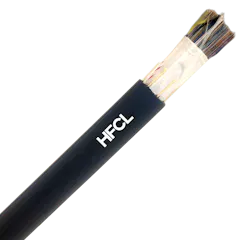

HFCL’s 3456F IBR Microcable (200μm) transforms the economics of ultra-high-capacity fiber deployment by combining speed, scalability, and sustainability.
Designed for hyperscale connectivity, long-haul, metro, and data center interconnect (DCI) networks, it enables operators to deploy extremely high fiber counts within constrained duct infrastructure while significantly reducing installation time and operational costs.
Up to 83% Reduced Installation Time
- HFCL’s 3456F IBR Microcable (200μm) enables mass fusion splicing, reducing installation time by up to 83% compared to loose fiber splicing.
- This capability allows operators to accelerate network rollout timelines for hyperscale connectivity, long-haul networks, DCI, and metro fiber deployments.
- The 3456F IBR Microcable (200μm) is engineered to be jetted into 1-inch ducts, ensuring optimal installation performance for ultra-high-capacity backbone networks.
Maximize Duct Utilization, Minimize Civil Costs
- The 3456F IBR Microcable (200μm) delivers extremely high fiber capacity within a compact cable geometry.
- The cable achieves approximately 14% smaller diameter compared to conventional 250 μm fiber designs while delivering an industry-leading fiber density of 9.98 fibers/mm².
- By enabling higher fiber counts within existing ducts, operators can significantly reduce the need for additional civil works and infrastructure expansion, resulting in up to 30% savings in deployment costs, especially in congested urban networks.
Achieve Operational Flexibility
The IBR construction provides both mass splicing capability and individual fiber access, allowing flexible network operations and simplified maintenance.The homogeneous and continuous cable jacket enables quick end and mid-span access, ensuring efficient field operations and long-term network reliability.
Multiple peripheral strength members eliminate the existence of a preferential bending plane, providing uniform flexibility and enhanced buckling resistance for rugged installation environments.
Cut Installation Time, Boost Productivity
The luffa-shaped sheath design minimizes duct contact points and enhances air drag, enabling a minimum single-shot blowing distance of 1500 meters under standard installation conditions.
Sustained installation speeds generally exceed 75 meters per minute, depending on duct conditions.
The cable also demonstrated stable performance under stationary high pressure inside jetting machines without distortion, validating its structural integrity during high-speed air-blown installation.
Longer blowing distances reduce intermediate jointing, shorten installation cycles, and improve field productivity for large-scale network deployments.
Forty-One Percent (41%) Lower Carbon Emissions
Compact design and Dry-Dry construction reduce material use and waste, achieving up to 41% lower carbon emissions than conventional 250-micron cable designs. Lightweight construction also decreases transportation and handling emissions, supporting operators’ sustainability commitments.
Deliver Scalable, Future-Ready Networks
The 3456F IBR Microcable (200μm) provides ultra-high fiber capacity for backbone and hyperscale connectivity applications. It is particularly suited for long-haul networks, DCI, and high-capacity metro networks, where compact design and high fiber density are essential.This architecture enables operators to scale network capacity efficiently while preparing infrastructure for future bandwidth demands.
Lower Total Cost of Ownership, Unlock New Revenue Streams
Faster rollouts, reduced installation effort, and reuse of existing duct infrastructure significantly reduce the Total Cost of Ownership (TCO). By deploying extremely high fiber capacity faster, operators can connect more customers, expand service coverage, and monetize network capacity earlier.
Market Alignment & Future-Proofing
The global ultra-high-density optical fiber cable market is projected to grow from $7.73 billion in 2025 to $17.77 billion by 2033, reflecting the increasing demand for compact high-capacity fiber infrastructure.
The 3456F IBR Microcable (200μm) aligns with this demand by enabling operators to deploy ultra-dense fiber networks efficiently while maintaining installation flexibility and sustainability.
Source: HFCL Limited