
Safeguarding Outside Plant (OSP) Infrastructure with Sensing Cables
Key Highlights
- Distributed Fiber Optic Sensing (DFOS) transforms existing fiber infrastructure into an early-warning system that detects and locates physical threats, including excavation, vibration, temperature changes, and structural movement, helping prevent service disruptions and reduce costly repairs.
- DFOS can leverage existing dark fiber, in-service fiber, and available rack space in outside plant cabinets, reducing the need for separate monitoring hardware, new enclosures, and additional field resources.
- By providing precise event locations, event classification, and risk-based alerts, DFOS helps operators identify potential issues earlier, prioritize field responses, dispatch crews more efficiently, and minimize subscriber outages while maximizing existing workforce productivity.
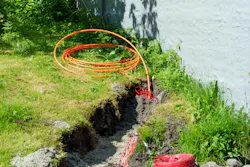
Turn the fiber in your outside plant into an early-warning system that helps detect and locate physical events before they impact service.
For decades, fiber optic cables in the outside plant have had one job: to carry traffic quickly and reliably. Fiber has been a transmission medium, not a source of information about what's happening around it. As a result, protecting fiber infrastructure previously required separate monitoring systems, which were typically deemed too expensive or used ineffectively.
The Common Ground Alliance’s most recent DIRT Annual Report1 showed more than 250,000 instances of damage to infrastructure in the field, with roughly a third of reports coming from telecom. Locator errors, excavator failures, and simply not calling for a locate request were the most common culprits. Whatever the cause, ISPs and telecom contractors know that fixing cut fiber lines is costly from a materials and labor standpoint.
A sensing-enabled fiber route offers a way to provide visibility without building a parallel network of separate monitoring hardware.
Distributed Fiber Optic Sensing (DFOS) changes that. By connecting an interrogator to a fiber and analyzing the signals that the sensing cables send back, operators can use fiber they already have—or fiber they're about to install—to detect physical events and changing conditions along the route.
The industry’s growing interest in DFOS is tied to a broader shift in how OSP networks are built. Providers continue to deploy more and more assets outside traditional central offices and staffed facilities. Think: wireless and small cell sites, edge compute and data center interconnects, utility corridors, transportation infrastructure, and smart city deployments. This telecom network infrastructure often sits in remote locations, making it harder to monitor with people. And installing cameras or standalone sensors at every site can grow very expensive, very fast.
A sensing-enabled fiber route offers a way to provide visibility without building a parallel network of separate monitoring hardware. Better still, this enhanced visibility comes from a technology that’s already used in these applications: fiber optics.
What DFOS Detects
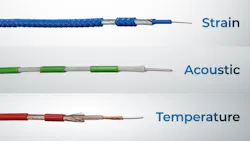
DFOS systems generally fall into three categories based on the physical change they monitor:
- Acoustic sensing detects vibration and sound energy coupled into the fiber. It's the category most associated with digging or excavation near a route, vehicle activity, equipment vibration, and intrusion or other disturbances near a site.
- Temperature sensing tracks heat changes along the length of the cable. That can be useful for outside plant infrastructure, but it’s even more relevant in central office or data center applications where temperature shifts serve as early indicators of developing problems.
- Strain sensing picks up stretching, compression, or movement in the fiber or the structure it's attached to. This ability is most beneficial along utility lines, bridges, pipelines, or other assets where physical stress matters.
Standard fiber can perform acoustic sensing to a certain extent, but purpose-built sensing cables are engineered to improve sensitivity to specific physical changes such as acoustic activity, temperature, or strain. The interrogator pulses the fiber with light and analyzes the returned backscatter to identify those changes along the route. What an operator can sense, and how well, depends on the overall sensing solution
Fitting Into Existing Infrastructure
Beyond what DFOS detects, a key question for outside plant professionals is where the equipment lives. Fortunately, adding sensing capability doesn't necessarily mean a new enclosure or power drop.
DFOS systems have three basic pieces: the interrogator, the fiber being monitored, and the software or analytics layer that turns raw data into usable events. The interrogator requires power, environmental protection, and connectivity just like other active electronics. Here, active cabinets deployed across most outside plant networks offer a natural fit to accommodate an interrogator.
Active cabinets are frequently sized with additional rack space for future growth. So, in many deployments, the new equipment could occupy rack units that are already built, powered, and sitting empty inside installed, permitted cabinets. That's a lower bar to clear than setting up new monitoring infrastructure from scratch. It’s also why engineers evaluate DFOS less like a new build and more like an extension of existing equipment.
Vendors with deep outside plant expertise have an edge when it comes to DFOS. Clearfield, for example, has engineered its DFOS sensing cables2 to feed directly into its existing active cabinets, central office infrastructure, and NOVA™ high-density fiber management platform. That integrated approach ensures the sensing layer extends the capabilities of any hardware that operators may already have in the field rather than requiring a parallel system.
This is good news for ISPs of all sizes that continue to face a tough labor market. Implementing DFOS can give existing operations teams greater visibility into OSP conditions.
This is good news for ISPs of all sizes that continue to face a tough labor market. By giving existing operations teams greater visibility into OSP conditions, DFOS can help crews identify and address issues more efficiently—maximizing the productivity of the workforce they already have and reducing the need to rely on additional field personnel.
An operations team working from a located, classified, risk-scored event has real information to act upon before a technician is ever sent to the field.
Brownfield and Greenfield Differences
How a DFOS deployment is built out tends to depend on whether the fiber is already in place.
In brownfield situations, many operators already have dark fiber or unused strands in the ground along strategic routes. Rather than treating that fiber as pure spare capacity, it can potentially be connected to an interrogator and put to work as an acoustic sensing system. Providers can leverage it to map the route, watch for construction or excavation activity nearby, flag physical disturbances, or provide continuous monitoring of critical routes. For many telcos and ISPs, this is the lowest-friction way to begin implementing distributed sensing, since the fiber cost is already sunk. However, to detect more specific acoustic signals, such as leak detection or animal movement, you will need specialized cable.
Greenfield DFOS projects work the other way around. Instead of harnessing existing fiber, the operator decides the sensing needs upfront and designs the network around that requirement. Wireless or tower sites, utility corridors, transportation projects, smart city buildouts, and perimeters around edge or data center sites—every application calls for a different sensing priority. Greenfield designs allow you to choose the cable and interrogator placement to match. A utility route focused on strain has different requirements than a perimeter application built around acoustic detection, and greenfield is where that distinction gets built into the network from the start.
Advantages for Operators
The bigger opportunity with DFOS is to give operators greater visibility into what is happening along their outside plant infrastructure, not just whether the network is carrying traffic.
Without sensing, the typical monitoring and response sequence in the outside plant is reactive. Something happens in the field, service may be affected, an alarm or trouble ticket is generated, and someone has to figure out what happened and where before a crew can be dispatched.
Sensing shifts some of that timeline to enable faster responses. With DFOS, operators can detect and locate physical events along their routes, whether that’s digging near a buried cable, unusual movement on a structure, an unexpected temperature swing, etc. They can then address the issue before it turns into a service-affecting failure, or at least dispatch crews faster to limit subscriber outages.
Detection alone isn't the only value. The value also comes from what the service provider’s team can do with that detection: whether the system can associate an event with a location, classify the likely event type, and assign a risk level before it ever reaches a human. Some large operators evaluating this technology have described exactly that kind of requirement:
- High-resolution localization across long stretches of route.
- The ability to work across both dark and in-service fiber without disrupting live traffic.
- Event data that arrives already triaged by risk so field teams know what they're walking into.
This is a meaningful shift from a trouble ticket that simply says something is wrong somewhere on a route. An operations team working from a located, classified, risk-scored event has real information to act upon before a technician is ever sent to the field.
Before Deploying DFOS
Because DFOS sits at the intersection of fiber, cable design, and active equipment, operators should consider and work through a few practical questions upfront:
- What is being detected? Is it acoustic activity, temperature, strain, or some combination?
- What level of location accuracy is required, and over what distance?
- Will the deployment use dark fiber, active, in-service fiber, or dedicated sensing fiber?
- Does the application call for a specialized sensing cable, or will standard fiber be adequate?
- Does the necessary equipment fit into existing rack space and cabinets already in the field, or does it require a new enclosure and site build?
- How will events be classified, and how will alerts reach the operations team that needs them?
- Who is helping to design the complete system—fiber, cable, enclosure, and analytics—rather than just supplying the sensing hardware?
That last question may matter most. DFOS is more than a software or analytics layer bolted onto existing fiber. It’s a comprehensive system that relies on getting the physical layer right. This is why it functions best as an extension of the same outside plant expertise that already goes into fiber selection, cable design, cabinet protection, and power planning.
Companies with a proven track record of outside plant excellence can apply their expertise to distributed fiber optic sensing, engineering cables, and interrogator integration. As a result, these operators can deploy DFOS as an extension of infrastructure they already have in the field, rather than a parallel build from scratch.
REFERENCES
Stay Connected with ISE Magazine
Subscribe to our newsletters and magazine for the latest telecom insights, explore the current issue for in-depth features and strategies, and register for upcoming webinars to learn directly from industry leaders.
About the Author
 Robert Paul
Market Development Manager, Clearfield
Robert Paul serves as a Market Development Manager at Clearfield, where he focuses on identifying growth opportunities and expanding the reach of fiber optic connectivity solutions. Based in Minneapolis, he brings an analytical foundation to the role, having previously served as a Senior Business Analyst at Clearfield.
His earlier experience across organizations including XPO Logistics and UnitedHealth Group reflects a career spanning logistics, healthcare, and telecommunications, along with a capacity to translate data into practical market strategy.
For more information, visit www.SeeClearfield.com. Follow Clearfield on LinkedIn and Facebook.