Coordination Isn’t Integration

ISE research suggests network silos are weakening. The harder task is extending integrated planning through construction, operations and the network’s eventual expansion.
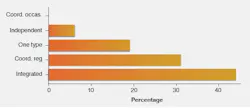
Ahead of ISE EXPO 2026, ISE surveyed 80 communications infrastructure professionals about infrastructure priorities, deployment barriers, and planning across fiber, wireless, broadband, and data center networks. Among respondents, 44% said their organizations use a single integrated planning process, while another 31% said separate teams coordinate regularly. 19% said they deploy only one network type, and 6% reported independent planning with little coordination.
Those answers suggest considerable coordination among this group of respondents. They do not, however, show which functions participate in planning or whether that collaboration continues as a project moves from design to construction and operations. (See Figure 1.)
That distinction shaped the discussion when the findings were presented during the “No More Silos: Building Hybrid Networks That Actually Work” session at ISE EXPO 2026. Panelists Kevin Czaicki, Vice President of Engineering and Strategic Solutions at Millennium, and Noah Taylor, Head of Market Intelligence and Growth Strategy for Broadband at AFL, described organizations that communicate successfully during design and construction but lose that integration as the network moves toward operation.
An organization can coordinate fiber and wireless planning, align procurement with construction, and still leave the completed network to an operations team that had little influence over its architecture, components, or long-term maintenance requirements.
The panel focused on whether and how coordination survives each project handoff.
Following the Network Through the Handoff
Czaicki described projects that begin with broad stakeholder participation but narrow once detailed design starts. At that stage, engineering may work primarily with whoever is responsible for the network design. Operations may not reenter the process until materials are being positioned, even though its personnel will ultimately own the finished infrastructure.
That handoff becomes more difficult when employees leave or move into other roles. Taylor described customers who inherited networks without knowing why particular designs or components had been selected. He recommended leaving a record of the reasoning behind those decisions so future employees do not have to reconstruct it during maintenance or replacement work.
Both speakers argued that operations should be involved earlier. Czaicki added that finance should participate early enough to distinguish an upfront saving from a decision that shifts costs into maintenance, repair, or future expansion.
Manufacturers represent another frequently overlooked part of the process. Taylor urged operators to discuss the problem they are trying to solve with manufacturers rather than sending only a bill of materials. An earlier conversation may give a manufacturer an opportunity to suggest a different product, installation method or design approach, including products still in development.
Taylor also connected early manufacturer involvement to demand forecasting. He said long lead times for adding new fiber-production capacity make it important for manufacturers to understand anticipated project requirements before orders are placed. Forecasting, procurement, and network design must then remain coordinated as routes, schedules, and material needs change.
For the panelists, the issue was continuity between design, procurement, construction, and operations. Each function performs different work, but decisions made by one group can determine the costs and constraints inherited by the next.
Planning for Several Futures
The survey findings show why that broader view has become necessary. When respondents were asked to select their highest infrastructure priority for the next 24 months, no single initiative emerged as the clear leader. Expanding fiber capacity, modernizing existing networks, supporting AI infrastructure, and improving network resiliency each received 19% of responses. Accelerating broadband deployment followed at 12%, while wireless and fiber integration and reducing deployment costs each received 6%.
Investment expectations add another layer of complications. Half of respondents selected data center connectivity as the infrastructure segment likely to receive the greatest investment increase over the next three years. Outside-plant fiber and wireless or fixed wireless access followed at 19% each.
Respondents were more divided about AI’s current influence on network planning. 25% said AI is becoming an important planning consideration, 25% said their organizations are evaluating future requirements, and 25% reported little impact so far. 13% identified AI as a primary investment driver, while 12% were unsure.
Taylor said much of today’s AI-related network activity is concentrated around data center interconnection and model training. He and Czaicki expect wider use of inference to push demand into other portions of the network and create less predictable traffic patterns.
The panelists’ design advice was to preserve capacity and physical space where future growth is plausible. For fiber projects, that may include additional fiber count, conduit space, expansion routes, and locations for future cabinets or facilities.
Taylor noted that the field labor required to place a 144-count cable is similar to the labor required for a 432-count cable. Czaicki added that, in his experience, returning years later to expand a route can cost two or three times as much once permitting, construction, and road closures are required again. Project economics will vary, but their recommendation was to consider expansion options before crews leave the field.
Higher density also introduces trade-offs, though. Taylor said ribbon fiber and ribbon splicing can accelerate construction at higher fiber counts, but concentrating more fibers in one cable increases the consequences of an outage: A single misplaced backhoe strike, for example, could affect substantially more capacity.
Czaicki also connected standardization to both successful construction and operations. Consistent engineering practices, materials, and network designs make it easier for employees to understand what they will encounter in the field. Service vehicles can also carry inventory that applies across more of the network. Standardization does not prevent operators from adopting improved products, he said, but it provides a common foundation for smaller changes.
As for the labor problem, Taylor proposed a two-part solution: making work easier for available employees and eliminating some field labor altogether. Products that are easier to install and train on may improve field productivity, while pre-terminated and plug-and-play solutions can move portions of the work into a controlled factory environment.
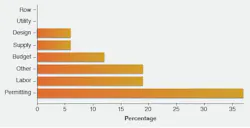
Permitting and regulatory approvals were the most frequently cited deployment obstacle, selected by 37% of respondents. Labor availability and “other” obstacles each received 19%, followed by budget limitations at 12%. Material or supply chain constraints and network design complexity each received 6%. (See Figure 2.)
Czaicki recommended dividing large deployments into constructible segments and sequencing work according to permit lead times, material availability, weather, and construction difficulty. He argued that this approach can reduce the risk of a single pending approval stalling the entire program. Taylor added that manufacturers may be able to suggest a product or construction method suited to a particular permitting constraint, while route diversity can support both the project schedule and network resiliency.
Integration After Construction
When respondents were asked to identify integration’s greatest expected benefit, faster deployment and greater capacity or scalability, each received 25%. Improved resiliency, better support for AI and edge applications, and simplified operations each received 12.5%. Lower operating costs and improved customer experience each received 6%. (See Figure 3.)
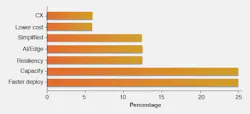
The low ranking of operating costs surprised both Taylor and Czaicki, the latter speculating that some respondents may be closer to network construction than long-term operation. In his experience, operators face pressure to control ongoing network costs even when initial construction is treated as an investment.
Taylor recommended continuing to measure integration after commissioning. If coordination and standardization improved construction speed, operators should examine whether those benefits carried into operations. Metrics such as mean time to repair can indicate whether technicians understand the network, have access to the correct information, and can obtain the materials needed to restore service.
Czaicki said customer experience provides another measure. He mentioned latency as one factor customers may notice even when competing providers offer similar advertised speeds.
The survey shows that many respondents describe their planning as integrated or regularly coordinated. The panel discussion raised a more specific question: whether that coordination is still present when designs change, materials are ordered, and operations takes responsibility for the completed network.
The panelists’ examples centered on what happens after construction, whether operations understand the design, whether technicians have familiar materials on the truck and whether future employees know why earlier decisions were made. Those outcomes show whether an integrated plan survived the handoff to the operating network.
Stay Connected with ISE Magazine
Subscribe to our newsletters and magazine for the latest telecom insights, explore the current issue for in-depth features and strategies, and register for upcoming webinars to learn directly from industry leaders.
About the Author
 Hayden Beeson
Hayden Beeson
Editor, ISE Magazine
Hayden Beeson is the editor of ISE Magazine at EndeavorB2B. He previously held editorial roles with Lightwave, Broadband Technology Report, LEDs Magazine and Architectural SSL.