Hubble Network Brings Direct-to-Satellite Connectivity to Bluetooth IoT Devices
Key Highlights
- Hubble Network has opened its satellite network to the public, enabling Bluetooth devices to connect directly to orbit through a firmware update without new hardware.
- The company raised $200 million, bringing its total funding to $300 million and its valuation to $1.6 billion.
- Growing IoT network: Hubble currently operates six LEO satellites and reports more than 500,000 active devices across a terrestrial network spanning 170 countries.
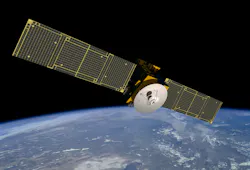
Hubble Network announced the opening of its satellite network to the public, enabling Bluetooth devices to connect directly to orbit. The company says its technology turns the Bluetooth LE radio already inside a device into a global beacon through a firmware update, without requiring new hardware.
For new designs, Hubble says connectivity adds less than 50 cents to the bill of materials, roughly 10 times less than a cellular modem and 50 times less than a satellite modem.
Cellular networks reach about 15% of the Earth’s landmass, according to Hubble. Tracking assets beyond that reach has required dedicated satellite hardware costing $25 or more per device, limiting satellite tracking to higher-value assets. Hubble says its approach could extend connectivity to a broader range of assets and devices.
Early satellite access was limited to a small number of pilot customers. Hubble now says any company on its Terrestrial Network can extend to satellite coverage through a firmware update. New customers can also register an off-the-shelf development kit through the Hubble dashboard and begin receiving data within minutes.
Samsara, one of Hubble’s pilot customers, is working to bring the satellite network to physical operations.
“Our customers work on the frontlines in some of the most remote parts of the world, where reliable connectivity can be hard to come by,” said David Gal, VP of Product and Engineering, Connected Equipment at Samsara. “Hubble gives us a way to extend visibility beyond the reach of traditional networks without adding new hardware—helping operators stay connected to critical equipment wherever the job takes them.”
Hubble currently operates six satellites in low Earth orbit and is on track to reach 60 by 2030. Its Terrestrial Network spans more than 100 million gateways across 170 countries and 3 million square miles of coverage. More than 500,000 devices are currently active on the network, more than 10 times the number a year ago.
“When we said we’d connect Bluetooth chips to satellites, most of the industry said the physics wouldn’t allow it,” said Alex Haro, CEO and co-founder of Hubble Network. “Today we’re turning that early skepticism into a global opportunity.
$200 Million Series C
Alongside the public opening of its satellite network, Hubble announced a $200 million Series C funding round led by Smith Point Capital, with participation from Seraphim, Carthona Capital, Earthshot Ventures, Y Combinator, and RPM Ventures. The round brings Hubble’s total funding to $300 million and values the company at $1.6 billion.
“Until now, the cost and complexity of connectivity limited visibility to only the most valuable assets,” said Keith Block, Founder and CEO of Smith Point Capital.
The latest funding round follows Hubble’s $70 million Series B raise in 2025.
Over the past year, Hubble has formed partnerships with Texas Instruments to enable customers to transmit location and sensor data without gateways, GPS, or cellular connectivity. Hubble also partnered with InPlay, which paired its sub-$1 chip with Hubble’s gateways to deliver item-level tracking at a cost comparable to passive RFID.
Smart-label maker Reelables has partnered with Hubble to connect printable smart labels to the network and extend cargo visibility. Hubble has also signed its first customer contract with Muon Space for larger next-generation satellites on its MuSat XL platform.
Source: Hubble Network
Stay Connected with ISE Magazine
Subscribe to our newsletters and magazine for the latest telecom insights, explore the current issue for in-depth features and strategies, and register for upcoming webinars to learn directly from industry leaders.